Gorbachev in Disneyland
A kind of unintentional parody hovers over everything, a tactical simulation, a consummate aesthetic enjoyment, is attached to the indefinable play of reading and the rules of the game.
A kind of unintentional parody hovers over everything, a tactical simulation, a consummate aesthetic enjoyment [jauisance], is attached to the indefinable play of reading and the rules of the game. Traveling signs, media, fashion and models, the blind but brilliant ambience of simulacra.
Jean Baudrillard Symbolic Exchange and Death (p. 74)
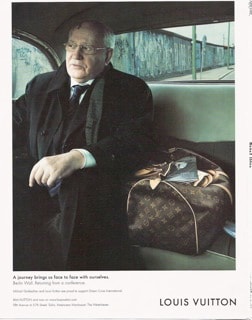
The ostensible purpose of this Louis Vuitton ad is to promote the company's luggage line by highlighting a popular bag known as a duffle. The work, like many of its kind, features a celebrity endorsement, but in this case the model is unexpected: the former General Secretary of the Communist Party of the Soviet Union, and first and last President of the Soviet Union, Mikhail Gorbachev. It would be an amusing choice of spokesman if it weren't so troubling.
Celebrity photographer, Annie Leibovitz, herself, a celebrity, shot the ad. It is a curious work and one we should not dismiss as representative of the kind of irony, so prevalent in contemporary advertising. There's something here, or not here, worthy of our attention, and I will use some of Jean Baudrillard's notions including seduction, simulacra and simulation to try to discover what it is and how to make sense of it.
When Is Seduction Not Seduction?
The intensity of the image is equal to its denial of the real.
Jean Baudrillard The Intelligence of Evil or the Lucidity Pact (p 97)
I open a magazine and am struck by an advertisement. It is an ad for the luggage maker Louis Vuitton, but I find myself describing the piece as by Louis Vuitton. This is not a slip of the tongue but some apprehension of a different kind of meaning. Is it an ad? Is it art? Is it entirely something else?
I call a few friends in the business, my business, advertising, and ask if they've seen this. To a one, they like it. Me, I find myself dismayed. I wonder what it is I'm actually seeing. I feel frightened, not seduced, by the image. Aren't I supposed to be seduced?
Baudrillard in his book Seduction writes: Where a linear movement knocks against the wall of consciousness and acquires only meager gains, seduction has the obliquity of a dream element or stroke of wit.
It is an ad's intention to seduce, to approach obliquity, to slip in, which is why one rarely attempts to tell the whole truth—"slice of life" is the preferred term; not true to life, just as movies are not true stories but based on true stories. An ad idealizes at best, deceives at worst. Its purpose is to transform an object or an idea into a desire.
Soon after it appeared, Eric Wilson, writing for the Times, in an article titled "Gorbachev Made Me Buy It," noted that Mr. Gorbachev is one of a number of celebrities appearing in a campaign conceived to "emphasize [Louis Vuitton's] heritage in luggage and travel accessories." He reminded us that Gorbachev was last President of the Soviet Union and quipped that he was "holding on to the [car] door handle as if the bag contained polonium 210."
For Wilson, Gorbachev is simply a celebrity model and that polonium 210, the radioactive substance linked to the gruesome death of the Russian spy Alexander Litvinensko, is a throwaway joke.
Wilson displayed an embarrassing ignorance of the craft and incredibly bad taste, but what bothered me was his lack of curiosity. He didn't ask: Why did Louis Vuitton select Gorbachev in the first place? One might say that his presence is counter-intuitive but what intuition does it counter? If we accept that the purpose of advertising is to seduce, how does this succeed?
Baudrillard draws our attention of the role of the eyes in seduction: "The most immediate, purest form of seduction, one that bypasses words." Gorbachev's eyes are turned from the camera. He's an old man, more Willy Loman than a figure of global importance. Why is he there? And, where exactly is he?
The End of Signification
The end of the spectacle brings with it the collapse of reality into hyperrealism, the meticulous reduplication of the real, preferably through another reproductive medium such as advertising or photography.
Jean Baudrillard Symbolic Exchange and Death (71)
An ad always represents, however the principal object on display is never the only object on view. Still, we expect the object to be central, and we read into it both real and symbolic meaning—today prestige is every bit as functional as capacity. So while the object for sale is useful, the nature this usefulness grows increasingly open to interpretation.
We are consumers of products but also consumers of advertisements. Each helps us fulfill our role. Increasingly ads impart less pure information, substituting signs that no longer signify anything. Gorbachev in this ad goes nowhere and yet we're told he's on a journey. As we'll see, anything that can act as a reference in this ad has, in a very real sense, stalled. They have lost their link to any original referent and the real and imaginary have, as Baudrillard observed, "combined."
The ad was placed in magazines where the brand name is recognized and prized and where the presence of these products confirms for the reader the importance of the magazine. But as we saw earlier what makes this ad stand out is the image of Mikhail Gorbachev—a historic figure. But nowhere in the ad can this fact be seen. The great reformer, whose reforms—perestroika and glasnost—ironically brought down the "house," appears in the ad as someone's tottering grandfather.
The ad's photographer, Annie Leibovitz, is well known for the meticulous care she takes to set the mise-en-scène. For all her effort, we see a weary looking Mikhail Gorbachev in the back seat of what appears to be a Soviet-era sedan. It is late fall or winter, the man wears a heavy coat and scarf. Out the back and side window we see what we are led to believe is the Berlin Wall, and what may in fact be the remaining stretch of the Wall near Ostbahnhof in Friedrichshain. It is a memorial grim enough to triggers memories of the late Ronald Reagan challenging Mr. Gorbachev to "Tear down this wall."
The use of political figures in advertising is no longer as unseemly as it once was and it's likely we'll only see more politicians lending their images to products, goods and services. Baudrillard remarked that advertising, "no longer has a territory," an observation I've taken to mean that it no longer has an obligation to stop expanding.
Words Without Meaning for Readers Who Won't Read
The copy in the ad reads hierarchically: A journey brings us face to face with ourselves. Berlin Wall. Returning from a conference.
A trite truism, followed by a false caption, leaves me wanting to know more. What journey is referred to here, what has Mr. Gorbachev seen along the way that has left him as stiff as Madame Tussaud's wax version of him?
The copy continues in increasingly smaller type, to signify that reading is beside the point. There's no meaning, just words on a page: "Mikhail Gorbachev and Louis Vuitton are proud to support Green Cross International." We are not told what Green Cross International is because we are not expected to read this far down the page. Baudrillard made the following observation apropos of graffiti, but I think it's applicable here: "[Words are neither connotations nor denotations, they escape the principle of signification. They refer back to nothing." In this ad only the address and a company logo—elements that formerly complete the ad—combine to form a genuine communication. This information alone is unambiguous.
What Is Real in This Ad?
So what is real here? Only the promise that this duffle bag exists and can be bought. The duffle, stacked on a store shelf, stored in a warehouse, is real. We may also say that certain underlying emotions suggested by the ad can be interpreted as true. Perhaps the choice of Gorbachev reflects a nostalgia for old cold-war certainties. Perhaps the odd setting, the grim and curiously intact Berlin Wall, suggesting a Berlin circa 1989, retains some charm for jet-setting consumers of Vuitton products.
An ad can be appreciated as a hyperreal object that occupies a hyperreal space. What's fascinating here is the ad's representation of a man who is no longer a leader and who sits in a car that isn't going anywhere. The narrative this ad constructs is a familiar story but not a true story. We might even describe it as its own pure simulacrum.
Although the line that separates them seems fainter every day, this is an ad, not photojournalism. Mr. Gorbachev is not really returning from a conference, despite what the copy claims. (Although it's likely the man is damned to attend conferences until he dies, this ad does not mark a specific event.) However the notion of a conference is worth examining, because like this ad, it is an event that really doesn't exist. A conference is a place where men and women (often supernumerary politicians) meet to meet, often only to agree to meet again, to discuss some issue of important to those who attend conferences. Increasingly conferences exist only to confer status on those who organize them and who attend them—think Aspen and Davos and the recent Clinton Global Initiative, scheduled to compete with the opening session of the General Assembly of the United Nations. These conferences also exist to provide news organizations with content—stories, footage and interviews. Which is to say conferences produce simulation of news for organizations that act as purveyors of news.
The truth is, everything is false in the ad, including such close attention to detail as the unzippered bag with a brochure and rolled newspaper conspicuously on top. If Gorbachev had reading material it would be stored in his attaché and not a duffle, which is designed for clothing and accessories. What more, it's increasingly less likely that a man reads in a car than talks on his phone or texts on his BlackBerry.
The world portrayed in this ad is a simulation of a world that owes its logic and sensibility to cinema—The Spy Who Came in From the Cold or The Bourne Identity—not historic or current events. It is all surface and refers to no real event we can refer to; although we can collective pretend it portrays a kind of reality. Apropos of simulation of this nature, Baudrillard wrote "The very definition of the real is that of which it is possible to provide an equivalent reproduction. At the end of this process of reproducibility, the real is not only that which can be reproduced, but that which is always already reproduced: the hyperreal."
Vuitton gives us a hyperreal Berlin, one seemingly indistinguishable from the real City. All that's required is something real, the wall or the unremitting gray of a Berlin winter, and you have the city. As Baudrillard wrote apropos of simulations and the hyperreal, "More real than the real, that is how the real is abolished."
It is also worth noting is that the photographer, Annie Leibovitz, is often more important than her subject. Ms. Leibovitz became famous for shooting rock stars and celebrities for Rolling Stone magazine. Later, she traded up to American Express advertising and Vanity Fair magazine where she made a career making idealized images that reinforced existing perceptions of her fabulous subjects. Oddly, Leibovitz, who famously creates animated and even extravagant beings, has given us a waxwork Gobachev—his body stiff as death.
Death and the Statesman
Death remains the ultimate risk in every symbolic pact, be it that supposed by a challenge a secret, a seduction or a perversion.
Jean Baudrillard Seduction
Studying this ad has led me to believe it is a meditation on death. In particular on the death of luxury as it becomes a commodity. The ad offers instructions on how to accessorize the dead. It is a joyless ad and one anticipated by Baudrillard when he wrote: "Advertising has been spoken of as a 'festival,'" since without it, the urban environment would be dismal. But in fact it is only a cold bustle, a simulacrum of appeal and warmth."
People who question whether or not men of Gorbachev's stature should appear in advertising, even if, as the ad suggests, any money he earns will go to a charity, miss the point. (The line in the copy is ambiguous, it appears that like Bill Clinton, Gorbachev doesn't donate money to his charity but encourages other people to donate to it.) The point is that leaders must now appear in ads to lead us to our deaths, wherever it will occur, whenever it will happen.
The bleak aspect of the ad, the pessimistic tone of the collage-like surface has a funereal-like fascination. I suspect this image is a Photoshop construction—the better to simulate reality. While it would be tempting to call the image false, in fact it has all the aesthetic integrity it requires. Which is to say that in this hyperreal image the signs of reality are an excellent substitute for reality.
In closing, I'd like to suggest that the Berlin setting brings to mind Baudrillard's observations on Disneyland. Like Disneyland, this Berlin is "a perfect model of all the entangled orders of simulation." It too is a "play of illusions and phantasm," but not with pirates, or frontiers, but an authentic historic figure, a Soviet-era automobile, a notorious concrete wall decorated with graffiti that isn't really graffiti—graffiti on the Berlin wall is not vandalism, the wall is vandalism.
As Baudrillard saw in Disneyland a third-order simulation, there to "conceal the fact that what we think of as real is no longer real but of the order of the hyperreal and simulation," so sophisticated ads of this nature exist to persuade the affluent to believe that their worlds are flourishing even if the intimations of their impending death are everywhere.
In the end, Gorbachev does not drive off. He is not on his way to a 5-star hotel, where someone will help him off with his coat and hand him a drink. The man is condemned. He is in purgatory, waiting for judgment day.